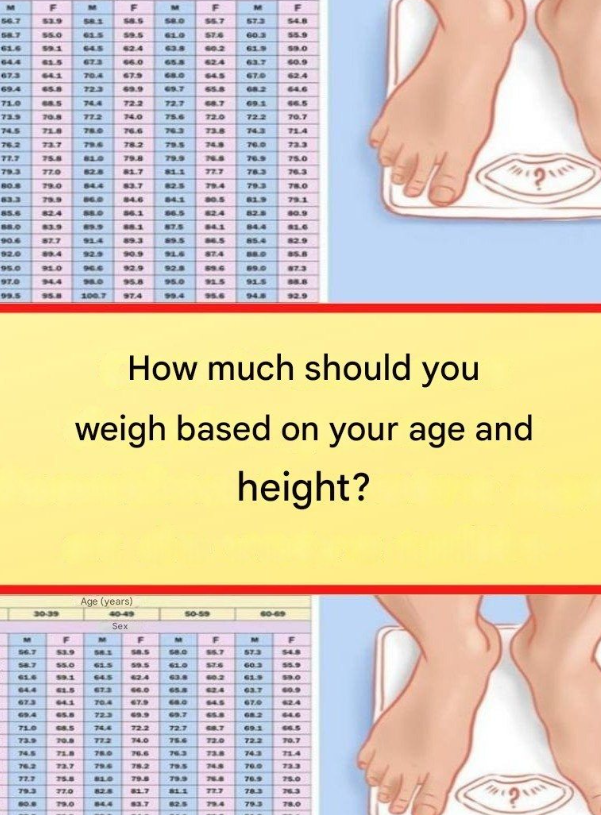
Exactly! BMI is a widely used tool to estimate a healthy weight range, though it has limitations—it doesn’t account for muscle mass, bone density, or body composition. Here’s a clear breakdown:
1. Calculating BMI
The formula is:
[
\text{BMI} = \frac{\text{weight (kg)}}{\text{height (m)}^2}
]
- Example: If someone weighs 70 kg and is 1.75 m tall:
[
BMI = \frac{70}{1.75^2} = \frac{70}{3.0625} \approx 22.9
]
2. BMI Categories (WHO Standard)
- Underweight: BMI < 18.5
- Normal weight: 18.5 – 24.9
- Overweight: 25 – 29.9
- Obesity: BMI ≥ 30
3. Converting to “Ideal Weight” Range
You can rearrange the BMI formula to find weight:
[
\text{Weight} = \text{BMI} \times (\text{height})^2
]
- For a height of 1.75 m:
- Lower healthy weight: (18.5 \times 1.75^2 \approx 56.6 \text{ kg})
- Upper healthy weight: (24.9 \times 1.75^2 \approx 76.2 \text{ kg})
So, a healthy weight range for 1.75 m is roughly 57–76 kg.
4. Limitations of BMI
- Doesn’t distinguish muscle vs fat (athletes may be “overweight” by BMI but healthy).
- Doesn’t account for age-related body changes.
- Doesn’t consider fat distribution, which affects health risk.
If you want, I can make a quick personalized “ideal weight chart” for your height, sex, and age that accounts for muscle and body type—much more practical than BMI alone.
Do you want me to make that chart?
